The farmers before Europe
The first farmers who entered Europe came from a population that had formed in Anatolia long before the Neolithic expansion began. Known as Anatolian Neolithic farmers, or ANF, this population developed from the hunter-gatherer communities of central Anatolia. Their history can be followed from the Caucasus during the Last Glacial Maximum to central Anatolia, where their descendants adopted farming and eventually carried it across the Aegean.
The earliest population in this sequence is represented at Dzudzuana Cave in present-day Georgia about 26,000 years ago. Dzudzuana derived around 72% of its ancestry from the branch shared with Villabruna-related hunter-gatherers in Europe and 28% from a Basal Eurasian population. The Dzudzuana and Villabruna branches separated approximately 26,000–31,000 years ago, near the beginning of the Last Glacial Maximum.
By 15,000 years ago, Dzudzuana-related ancestry was present among the hunter-gatherers of Pınarbaşı in central Anatolia. These Anatolian hunter-gatherers, or AHG, became the principal source of ancestry in the Aceramic farmers later sampled at Boncuklu. Their descendants formed the ANF population that expanded through western Anatolia and the Aegean before reaching Europe.
Later Ceramic Neolithic Anatolians, labelled ACF, received additional ancestry through a Levant_N-related population. Levant_N was itself approximately half Natufian-related and half Anatolian-farmer-related, so this mixture added about 10% Natufian-related ancestry to ACF while most of its ancestry remained Anatolian-related.
Anatolia, the Levant and the Zagros therefore began the Neolithic with genetically different farming populations. Each had formed largely from hunter-gatherers already living in its own region. Mixture between them increased during the Neolithic and created the connected Near Eastern ancestry landscape seen in later populations.
Farming crosses into Europe
By the seventh millennium BCE, farming communities related to western Anatolian and Aegean populations were established in Greece and the Balkans. Their arrival brought a new way of life, but the genomes show that migration carried the people as well as the crops and livestock.
The earliest Balkan farming groups had very little ancestry from the hunter-gatherers already living in Europe. A Middle Neolithic group from Croatia, for example, was estimated at 97.6% Anatolian-farmer-related ancestry and 2.4% Western hunter-gatherer ancestry. The data even allowed a model with no measurable hunter-gatherer contribution. These early Balkan groups provide the clearest genetic starting point for the spread farther north and west.
Communities associated with Starčevo, Körös and Criş carried farming through the Balkans and into the Carpathian Basin. From there, one expansion followed the rivers and fertile loess plains of central Europe. Another moved by sea and along the Mediterranean coast.
The Danube corridor also remained a zone of contact. At the Iron Gates, hunter-gatherer communities continued fishing and foraging while farmers settled farther south and west. Burials and genomes record movement in both directions: people with farmer ancestry entered hunter-gatherer communities, while descendants of local foragers became incorporated into farming settlements. The small hunter-gatherer contribution measured in early Balkan farmers therefore conceals considerable variation between places and individuals.
The Linear Pottery expansion
The inland expansion is closely associated with the Linearbandkeramik, or LBK, whose settlements stretched from Hungary to the Rhine within a few centuries. Most LBK ancestry came from Anatolian farmers, yet recent sampling shows that eastern and western LBK communities did not follow exactly the same genetic history. Eastern LBK sites carried systematically more Western hunter-gatherer ancestry than western ones.
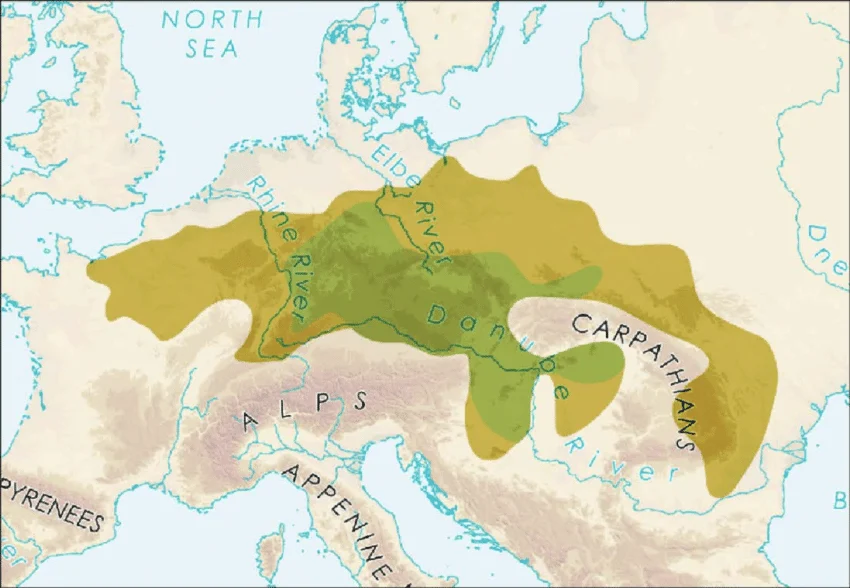
Across the main LBK population sampled in Germany, hunter-gatherer ancestry averaged approximately 4–5%. About 95–96% of the ancestry was therefore inherited from the Anatolian-derived early European farmer population. This farmer-dominated profile is characteristic of the LBK expansion as a whole, although eastern LBK communities generally carried somewhat more Western hunter-gatherer ancestry than western LBK communities.
Large cemeteries show that LBK society itself was diverse. Some settlements drew marriage partners from considerable distances, and women were often more mobile than men. Other sites reveal close biological relatives buried together across several generations. Genetic ancestry, household membership and archaeological culture therefore operated at different scales: a person could participate fully in an LBK community while carrying a family history unlike that of neighbours in the same settlement.
After about 5000 BCE, the LBK world fragmented into regional traditions including Stroke-Ornamented Ware, Lengyel and Rössen. The farming population remained largely descended from the first central European colonists, while renewed mixture with hunter-gatherers gradually increased local ancestry. Central Europe's Neolithic population was already changing long before steppe ancestry arrived.
The Mediterranean expansion
A second expansion followed the coasts of the Mediterranean. Communities associated first with Impressa pottery and later with Cardial Ware crossed the Adriatic into southern Italy and moved rapidly toward southern France and Iberia. Islands, short sea crossings and coastal plains connected this route. Farming could appear hundreds of kilometres away within a few generations, a pattern that is difficult to explain without repeated movement by boat.
The Mediterranean farmers shared the same broad Anatolian origin as the Balkan and LBK populations, but they followed a separate demographic history. In Italy, their genomes remained strongly farmer-related. Farther west, repeated contact with local hunter-gatherers steadily increased the forager contribution.
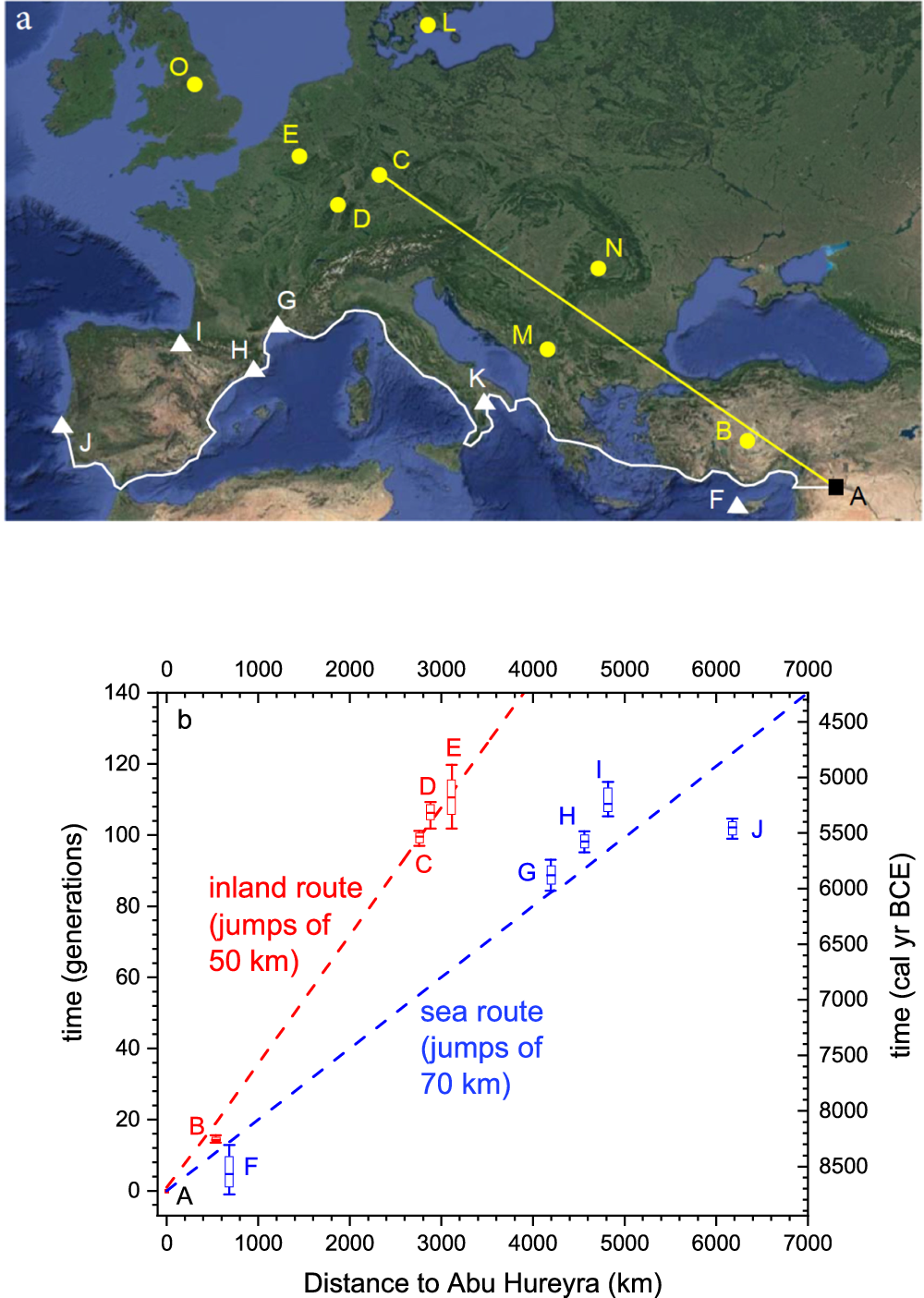
Southern France became especially complex because communities linked to the Mediterranean route met populations connected to continental Europe. Some sites contain people with very different proportions of farmer and hunter-gatherer ancestry. Kinship studies also identify individuals who had recently arrived from elsewhere, showing that mobility continued after permanent villages had formed.
The two routes eventually overlapped. Pottery traditions, livestock and people moved between continental and coastal networks, while local communities selected and recombined those influences. Archaeological labels such as LBK, Impressa and Cardial describe recognisable traditions, but their boundaries never formed genetic walls.
Farming reaches Iberia, France and Britain
Farmers reached Iberia during the second half of the sixth millennium BCE. Their arrival was driven mainly by migration, but mixture with the peninsula's hunter-gatherers began early. Individuals from the Early Neolithic site of Els Trocs were modelled with approximately 6.8–11% hunter-gatherer ancestry, leaving roughly 89–93.2% farmer-related ancestry in that two-source comparison. By the Middle Neolithic, individuals from La Mina carried approximately 18.9–22.8% hunter-gatherer ancestry and about 77.2–81.1% farmer-related ancestry.
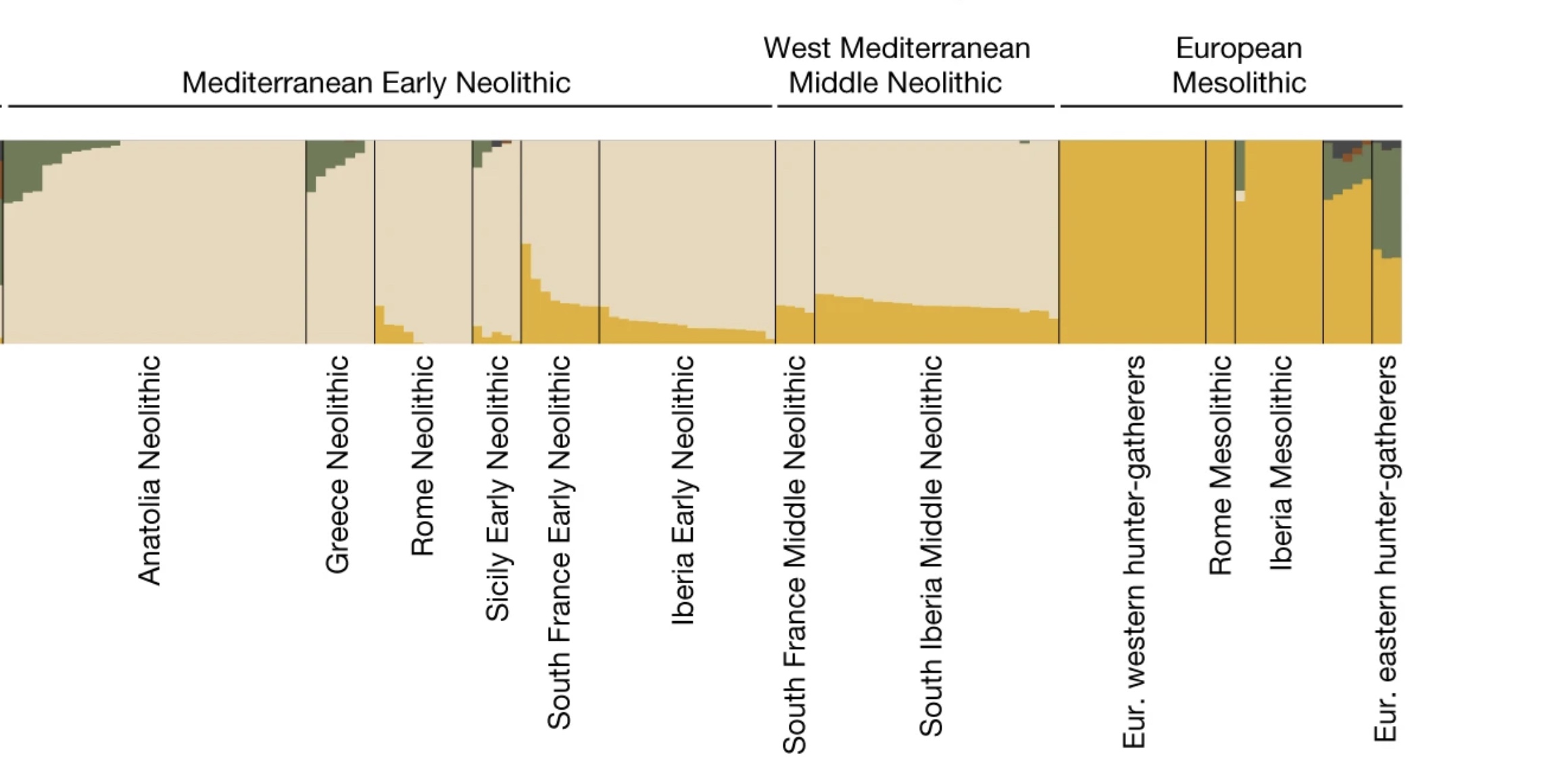
Coastal settlements connected to Mediterranean exchange often remained strongly farmer-related, while inland groups carried more local ancestry. The increase from Els Trocs to La Mina forms part of the wider hunter-gatherer resurgence documented across Neolithic Iberia.
France lay between the Mediterranean, Iberian and central European worlds. Early southern farmers were related to the Cardial expansion, whereas northern groups had stronger connections to continental farming populations. Later communities mixed these histories. By the fourth millennium BCE, megalithic societies along the Atlantic facade linked western France, Iberia and the British Isles through maritime exchange.
Farming reached Britain around 4000 BCE. British Neolithic people derived most of their ancestry from continental farmers whose deeper route ran through the Mediterranean and Iberia before turning north through France. Local Mesolithic ancestry was generally limited, although it varied between individuals. The transition was therefore associated with a substantial movement of people across the Channel, followed by the growth of regional British communities.
The western Mediterranean islands
Island populations preserve some of the clearest regional histories. Neolithic settlers reached Sardinia by sea and established a population dominated by early-farmer ancestry. From the Middle Neolithic through the Nuragic period, a two-source model estimated the sampled Sardinians at 83 ± 2% Anatolian-farmer-related ancestry and 17 ± 2% Western hunter-gatherer ancestry. This balance remained unusually stable for several millennia.
Sardinia's continuity made ancient Sardinian genomes important references for the western branch of European farmer ancestry. Sicily followed a different course because its central position brought repeated contact with Italy, the Aegean and the eastern Mediterranean. Corsica and the Balearic Islands developed their own profiles through separate migration routes and founder events.
Sea travel created isolation and connectivity at the same time. Founder events could preserve ancestry for centuries, while later voyages introduced new families and altered the population. The genetic history of each island depended on its location within changing maritime networks.
Hunter-gatherer ancestry returns
Across much of Europe, Middle Neolithic farmers carried more hunter-gatherer ancestry than the first farming settlers. This increase is often called the hunter-gatherer resurgence. It began at different times and reached different levels from Iberia to central Europe and the Baltic.
The ancestry usually came from hunter-gatherers related to the same region. Iberian farmers were shifted toward Iberian foragers, while central European farmers drew ancestry from hunter-gatherers closer to central and western European samples. Surviving forager communities were absorbed independently across different parts of Europe.
The process unfolded through ordinary social relationships: marriage, adoption into communities, movement between settlements and the eventual disappearance of separate forager economies. Some individuals had a hunter-gatherer ancestor only a few generations earlier; others belonged to families that had been farmers for centuries. Population averages compress those different lives into a single percentage.
Funnel Beaker farmers reach northern Europe
Farming reached southern Scandinavia around 4000 BCE with communities known as Funnel Beaker, or TRB. The Danish genomes record an abrupt population turnover: the local Ertebølle hunter-gatherers were replaced by incoming farmers with ancestry ultimately derived from Anatolia.
These northern farmers had already absorbed substantial hunter-gatherer ancestry. Danish Funnel Beaker individuals carried about 10–35% hunter-gatherer ancestry and approximately 65–90% farmer-related ancestry in the models reported by Allentoft and colleagues. Most of the forager contribution was Western hunter-gatherer-related. Swedish Funnel Beaker populations likewise combined central European farmer ancestry with ancestry from local foragers.
Farming did not eliminate forager societies around the Baltic. Pitted Ware communities lived beside Funnel Beaker farmers and retained ancestry close to Scandinavian Mesolithic hunter-gatherers. Two Pitted Ware-like men found in Denmark show that maritime forager networks crossed the Baltic while farming settlements occupied the same wider region.
This coexistence lasted for centuries. Funnel Beaker groups built monuments, kept livestock and cultivated crops, while Pitted Ware communities relied heavily on marine resources and maintained links across the Baltic. Material exchange did not immediately produce genetic homogenisation. Northern Europe remained a frontier where different populations shared landscapes while preserving distinct ancestry profiles.
By the late fourth millennium BCE, Funnel Beaker ancestry itself varied across Scandinavia. Some groups carried stronger central European farmer ancestry; others had absorbed much more local hunter-gatherer ancestry. TRB is consequently an archaeological umbrella covering communities with related economies but different demographic histories.
Globular Amphora Europe
Between about 3400 and 2800 BCE, Globular Amphora communities occupied a broad zone across Poland, Ukraine and neighbouring parts of central and eastern Europe. Their genomes reveal a farmer-majority population with considerably more hunter-gatherer ancestry than the earliest central European farmers.
The proportions differed between Globular Amphora communities. Individuals from Vliněves in Bohemia carried approximately 72–80% Anatolian-farmer-related ancestry and 20–28% Western hunter-gatherer ancestry. At Koszyce in southern Poland, the balance was close to 70% farmer-related and 30% hunter-gatherer-related ancestry. Both groups carried considerably more hunter-gatherer ancestry than the earliest Balkan and western LBK farmers.
The mass grave at Koszyce in southern Poland gives this population a human scale. Fifteen people were killed and buried together around 2880–2776 BCE. Genome-wide data showed that they belonged to several closely connected nuclear families. Mothers were buried beside children and siblings, while many adult men were absent. The cemetery demonstrates that Globular Amphora communities were organised through extended biological kinship as well as shared material culture.
The sampled Globular Amphora groups carried no detectable steppe ancestry, even though steppe-influenced populations already lived nearby. They were therefore genetically different from the Corded Ware populations that followed. Recent identity-by-descent analysis nevertheless found close links between Globular Amphora and the farmer-related ancestry in Corded Ware. Globular Amphora-related people appear to have been an important local farming source absorbed during the later transformation.
Cucuteni-Trypillia at the steppe frontier
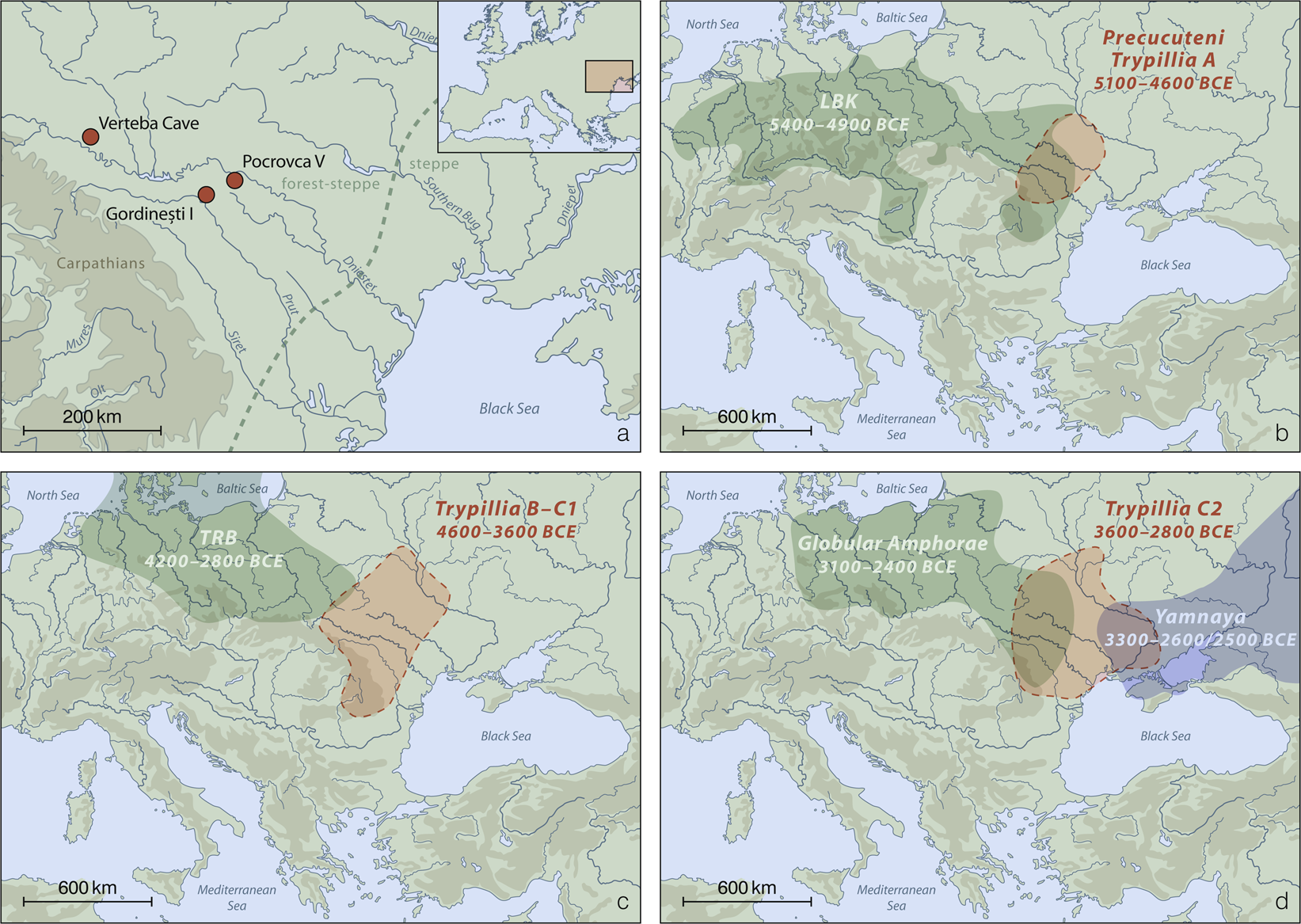
Cucuteni-Trypillia settlements covered parts of present-day Romania, Moldova and Ukraine from the fifth into the fourth millennium BCE. Genome-wide samples from Verteba Cave carried roughly 80% Neolithic-farmer-related ancestry and 20% hunter-gatherer-related ancestry. The forager component included ancestry connected to both western and eastern European hunter-gatherers.
Later communities acquired ancestry from the neighbouring steppe. Four people from Moldova dated to 3500–3100 BCE carried different amounts of steppe-related ancestry. A larger Verteba series also recorded this change: most later individuals fitted Eneolithic sources that already contained steppe ancestry, while a smaller group remained closer to the earlier farmer-rich profile.
Trypillia's enormous “mega-sites”, some containing thousands of houses, developed along this farming-steppe frontier. Their inhabitants exchanged animals and objects with steppe communities for centuries, followed by increasing movement and intermarriage during the fourth millennium BCE.
The end of Neolithic farming Europe
From about 3000 BCE, Corded Ware and related populations spread across much of central and northern Europe. Their genomes mark a major shift. Early Corded Ware individuals in Germany were modelled with roughly 75% Yamnaya-related steppe ancestry. In Denmark, one of the earliest steppe-rich individuals carried about 85%.
The remaining ancestry did not come from a generic European farmer population. Genetic links point especially toward eastern farming groups related to Globular Amphora. Corded Ware populations therefore formed through a combination of incoming steppe ancestry and people descended from the Neolithic communities already living in central and eastern Europe.
The change was rapid but uneven. In Denmark, farmer-rich and steppe-rich people briefly lived at the same time before the older Funnel Beaker profile disappeared from the sampled sequence. Elsewhere, steppe ancestry had already entered some Trypillia and neighbouring Eneolithic communities before Corded Ware became widespread.
By the beginning of the Bronze Age, Europe no longer consisted of separate farmer and hunter-gatherer populations. Thousands of years of local mixture had produced regional Neolithic groups, and the steppe expansion joined those groups into another new ancestry landscape. The farmer ancestry that first crossed from Anatolia remained a major part of the European genome, carried forward through LBK, Cardial, Funnel Beaker, Globular Amphora and other communities.