Early expansions and the Gravettian divide
Homo sapiens expanded out of Africa roughly 70,000 to 60,000 years ago and reached Europe by at least 45,000 years ago. One genome from this period comes from Zlatý kůň in Czechia. She descended from an early Eurasian population that separated before the ancestral lines of later West and East Eurasians split from one another. Her population appears as a genetic dead end in the available record, with no detectable contribution to later groups.
Around 45,000 years ago, populations associated with the Initial Upper Palaeolithic expanded from a proposed population hub on the Iranian Plateau. Groups moving eastward across Asia contributed to the ancestry represented by the approximately 40,000-year-old Tianyuan individual in China and by later East Eurasian populations. Other groups moved westward into Europe, where their ancestry is represented by the approximately 45,000-year-old genomes from Bacho Kiro Cave in Bulgaria.
The Bacho Kiro IUP population was later largely replaced in Europe by a second expansion carrying West Eurasian Core ancestry. The replacement changed the main ancestry of subsequent European populations, but a smaller Bacho Kiro IUP-related contribution remained in the western lineage that later included Goyet Q116-1 and the Fournol cluster.
That second expansion reached Europe around 38,000 years ago and became the main ancestry base of the Upper Palaeolithic Europeans who followed. Kostenki 14 and Sunghir represent its eastern European side. Farther west, a separate branch developed into the ancestry later found in the Fournol cluster.
By the Gravettian period, between about 33,000 and 26,000 years ago, the sampled populations of Europe formed two major genetic clusters. The Věstonice cluster included Gravettian people from central, eastern and southern Europe, including Dolní Věstonice, Pavlov, Krems-Wachtberg, Paglicci and Ostuni. The Fournol cluster included Gravettian people from western and southwestern Europe, including Ormesson, La Rochette, Fournol and the Serinyà caves.
The remaining Bacho Kiro contribution became an important difference between the two Gravettian clusters. In the qpGraph published by Posth and colleagues in Nature in 2023, the western branch represented by Goyet Q116-1 and Fournol carried about 17% Bacho Kiro IUP-related ancestry. This increased its genetic affinity to early East Eurasian-related populations and distinguished Fournol from the Kostenki- and Sunghir-related ancestry dominant in Věstonice.
The Věstonice cluster carried a smaller Bacho Kiro IUP-related contribution. Its ancestry was modelled as 64% from the Sunghir-related branch, which received no Bacho Kiro IUP contribution in this graph, and 36% from the western branch carrying the 17% Bacho Kiro-related component. Multiplying those layers gives Věstonice an estimated Bacho Kiro-related share of roughly 6%, compared with about 17% in the Goyet/Fournol branch. Fournol therefore carried almost three times as much of this eastern-shifted ancestry. That difference is the main reason Fournol forms a western cluster while Věstonice remains genetically closer to Kostenki and Sunghir.
Goyet Q116-1 itself lived about 35,000 years ago during the Aurignacian, before the Gravettian Fournol cluster formed. It matters because its genome reveals the mixed ancestry already present on the branch from which Fournol later separated.
Population turnover during the Last Glacial Maximum
Between about 26,000 and 19,000 years ago, glaciers covered much of northern Europe and large areas farther south became too cold and dry to support human settlement. Hunter-gatherers withdrew into the more habitable parts of southern Europe. Ancient DNA shows that these refuges did not preserve one continuous European population. The groups that survived in France and Iberia followed a different history from those that emerged in Italy.
In France and Iberia, descendants of the Fournol cluster survived the coldest part of the Ice Age. As the climate improved, their Magdalenian descendants expanded northward and eastward across western Europe. Italy experienced a more complete population change. The Věstonice-related ancestry found there before the glacial maximum disappears from later genomes and is replaced by a different population known as the Villabruna cluster.
Villabruna takes its name from a hunter-gatherer buried at Riparo Villabruna in northeastern Italy. Villabruna-related hunter-gatherers shared more alleles with ancient Anatolian hunter-gatherers and Near Eastern populations, including Natufians. This connection developed before farming: genetic models place the separation between Villabruna and its eastern relatives at roughly 26,000 years ago.
The most likely route brought these hunter-gatherers from the Balkans into northeastern Italy, followed by an expansion southward. Although the first stages remain difficult to date because genomes from the coldest part of the Ice Age are scarce, the available evidence shows that Villabruna had replaced the earlier Věstonice-related population in Italy by around 17,000 years ago.
Western and southern Europe did not remain isolated from one another. Magdalenian groups descended mainly from Fournol also acquired Villabruna-related ancestry, while populations expanding from Italy later carried a smaller contribution related to the older western European hunter-gatherers. By about 14,000 years ago, these movements had produced the Oberkassel cluster: the ancestry profile usually called Western hunter-gatherer, or WHG.
The formation of Western hunter-gatherer ancestry
Around 14,000 years ago, a remarkably consistent ancestry profile appeared across western and central Europe. Two people buried at Oberkassel in western Germany, a man and a woman who lived at the end of the Ice Age, provide its earliest clear evidence north of the Alps. Ancient-DNA researchers use their site name for the wider Oberkassel cluster. This is the genetic profile usually described as Western hunter-gatherer ancestry, or WHG.
Oberkassel formed from populations with different Ice Age histories. Most of its ancestry came from the Villabruna-related population that had spread through Italy. A smaller contribution came from the Fournol-related lineage that survived the glacial maximum in France and Iberia and later dominated Magdalenian groups. The resulting population connected the post-glacial inhabitants of western and central Europe to both southern refuges.
The exact percentages change with the ancient samples chosen as proxies. Posth and colleagues obtained one model with approximately 75% ancestry represented by Arene Candide 16, an Italian Villabruna-cluster individual, and 25% represented by Goyet Q-2. Replacing Goyet Q-2 with the older Fournol 85 individual produced a model of roughly 90% Villabruna-related and 10% Fournol-related ancestry. Both models describe a predominantly Villabruna-related population that absorbed ancestry descended from the older western European lineage.
The geographical consistency of the cluster is important. Hunter-gatherers from Germany, France and Britain carried closely similar ancestry after about 14,000 years ago. Independent mixtures between Villabruna-related newcomers and local Magdalenian groups would have produced more regional variation. The data instead indicate that the mixture was already largely established before Oberkassel-related people expanded across western and central Europe.
This expansion followed the rapid warming at the beginning of the Bølling–Allerød interstadial, when forests and habitable landscapes spread northward. Communities moved into territories that had been sparsely populated during the coldest millennia. By the early Holocene, Oberkassel-related ancestry extended from Italy and Iberia through central Europe to Britain. Mitochondrial haplogroup U5 and Y-chromosome haplogroup I were frequent among these western hunter-gatherers, although the autosomal genome defines the Oberkassel cluster.
For several thousand years the population remained genetically distinct from hunter-gatherers farther east. Samples from western and central Europe dated between about 14,000 and 8,000 years ago can generally be modelled without the eastern Sidelkino-related ancestry that later entered the region. Europe therefore began the Holocene with a strong west-to-east division between Oberkassel and the emerging eastern hunter-gatherer population.
Genetic continuity in post-glacial Iberia
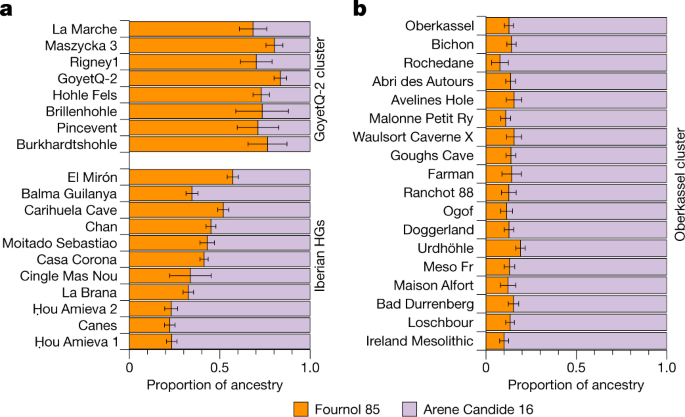
The arrival of Villabruna and Oberkassel ancestry did not replace the older population of Iberia. The newcomers mixed with descendants of the Fournol-related groups that had survived the Last Glacial Maximum in the southwest. This produced a series of local mixtures rather than one uniform Iberian hunter-gatherer population.
El Mirón, who lived in northern Spain about 19,000 years ago, can be modelled as approximately 57% Fournol-related and 43% Villabruna-related. Among Iberian hunter-gatherers living after 14,000 years ago, the estimated Fournol contribution varies from roughly 21% to 51%. Northern groups such as La Braña and Canes later received more Oberkassel ancestry, whereas populations farther south and west generally retained a larger share of the older Fournol-related ancestry.
The same continuity appears on the Y chromosome. Haplogroup C was common among European hunter-gatherers before the Last Glacial Maximum but became rare across most of Europe afterwards. In Iberia it survived into the Mesolithic, providing a second line of evidence that part of the pre-glacial population endured there.
The formation of Eastern hunter-gatherer ancestry
The Ancient North Eurasian contribution
Eastern Europe drew ancestry from a population history that had developed far beyond the post-glacial forests of the west. Ancient North Eurasian ancestry is named after Upper Palaeolithic Siberian genomes, especially the approximately 24,000-year-old Mal'ta 1 individual near Lake Baikal and the roughly 17,000-year-old Afontova Gora 3 individual from the Yenisei region. These Siberian hunter-gatherers belonged to a deeply separated West Eurasian-related lineage and contributed ancestry to several later populations across northern Eurasia.
The Ancient North Eurasians did not enter Mesolithic Europe as one intact population. Their ancestry had already passed through later northern Eurasian groups before it became part of the eastern European hunter-gatherer gene pool. Genetic models use Mal'ta or Afontova Gora as proxies for this Siberian-related side of the mixture. Among those proxies, the Sidelkino cluster shows a closer relationship to Afontova Gora 3.
At the end of the Ice Age, this Siberian-related ancestry met hunter-gatherers related to Villabruna and Oberkassel on the eastern European plain. Admixture dating places that mixture between approximately 15,000 and 13,000 years ago, close to the major climatic warming of the Bølling–Allerød. Their descendants formed the ancestry commonly called Eastern hunter-gatherer, or EHG.
The Sidelkino cluster
Posth and colleagues use the name Sidelkino cluster for this eastern profile. The name comes from an approximately 11,000-year-old hunter-gatherer from the Samara region of western Russia. Sidelkino combines a western hunter-gatherer-related component with a substantial Ancient North Eurasian-related component. Two-source models place the balance close to half from each side, although the estimate changes with the Villabruna, Oberkassel and Siberian proxy samples used.
The cluster is also visible in a much larger group from Yuzhniy Oleniy Ostrov in Karelia. Nineteen individuals buried there around 8,200 years ago carried a closely related eastern profile. Their genomes show why Sidelkino is useful as a population label: it describes an ancestry pattern found across widely separated eastern hunter-gatherer communities rather than the inhabitants of one burial site alone.
The formation process was gradual. An approximately 13,000-year-old individual from Peschanitsa in western Russia already carried both western and Siberian-related ancestry, but with more affinity to Oberkassel than the later Sidelkino profile. Individuals from Minino, dating to around 11,000 years ago, also retained additional Oberkassel-related ancestry. The eastern plain therefore contained related communities with different mixture proportions before the more characteristic Sidelkino profile became widespread.
Maternal and paternal lineages further distinguish the sampled eastern population. Mitochondrial haplogroups U2, U4 and branches of R occur frequently, while Y-chromosome haplogroups Q, R and J appear in the eastern dataset. These markers support a different demographic history from Oberkassel, where U5 and Y-chromosome I were more common, while the genome-wide data provide the basis for defining the two clusters.
A contact zone moved across Europe
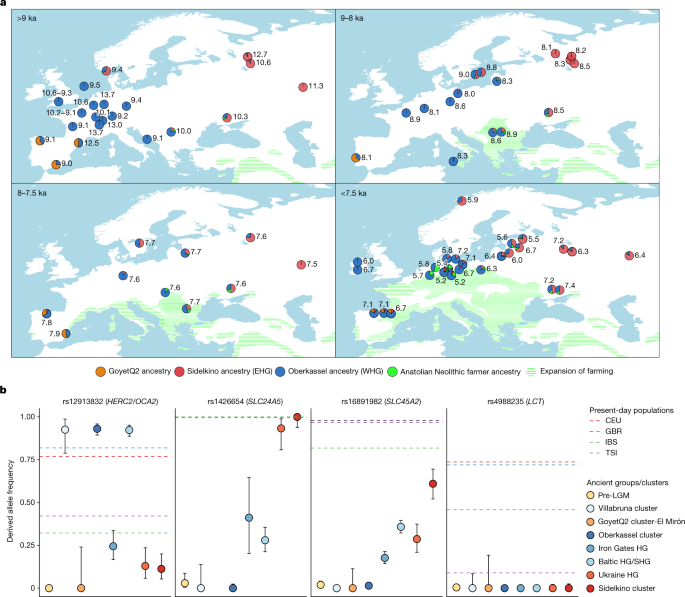
For much of the early post-glacial period, Oberkassel and Sidelkino occupied opposite ends of Europe. Hunter-gatherers sampled in western and central Europe between about 14,000 and 8,000 years ago show no detectable Sidelkino contribution. Farther north and east, the separation was already breaking down. Populations in Scandinavia, the Baltic, Ukraine and the Iron Gates of the Balkans carried different mixtures of western and eastern hunter-gatherer ancestry, forming a broad contact zone between the two centres.
Around 8,000 years ago the eastern contribution crossed into central Europe. It appears at Gross Fredenwalde in northeastern Germany and soon reaches roughly 10% in many later hunter-gatherers farther west. Northern Iberian groups also received a small eastern contribution, while contemporaneous individuals from eastern Spain lacked it. This uneven distribution records movements through particular networks rather than one uniform migration across the continent.
Gene flow also continued eastward. Additional Oberkassel-related ancestry appears at Minino and Yazykovo by at least about 7,500 years ago, although aquatic reservoir effects make some radiocarbon dates uncertain. By approximately 6,500 years ago, western hunter-gatherer-related ancestry had reached the Samara region itself. In the Baltic, the proportion of Sidelkino-related ancestry increased during the transition from Narva-associated groups to Comb Ceramic communities.
Farming populations entered central Europe after roughly 7,500 years ago, narrowing the areas in which hunter-gatherer ancestry remained dominant. Some communities nevertheless retained very high hunter-gatherer ancestry for millennia. The approximately 5,200-year-old people from Ostorf in northern Germany carried more than 90% combined Oberkassel- and Sidelkino-related ancestry. By then, the old east-west division had become a gradient of mixed hunter-gatherer populations extending across northern Europe.