A language family spread across Eurasia
Indo-European languages occupy an extraordinary geographic range. Celtic and Germanic languages reached the Atlantic, Indo-Iranian languages spread across Central and South Asia, and the extinct Tocharian languages were recorded in the Tarim Basin of western China. Greek, Armenian, Balto-Slavic, Italic and the languages of ancient Anatolia belong to the same wider family.
Linguists had already reconstructed a common ancestor from regular similarities in vocabulary and grammar. Ancient DNA added a second line of evidence by tracing the populations that moved during the period in which the major branches separated. The strongest connection is between the non-Anatolian branches and the Yamnaya expansion from the Pontic-Caspian steppe after the middle of the fourth millennium BCE.
Anatolian languages created the harder problem. Hittite, Luwian and their relatives separated before the common ancestor of the remaining Indo-European branches, yet Bronze Age Anatolians lacked the large Yamnaya ancestry found farther north. The population ancestral to both branches therefore had to predate Yamnaya and connect the steppe with Anatolia.
The steppe before Yamnaya
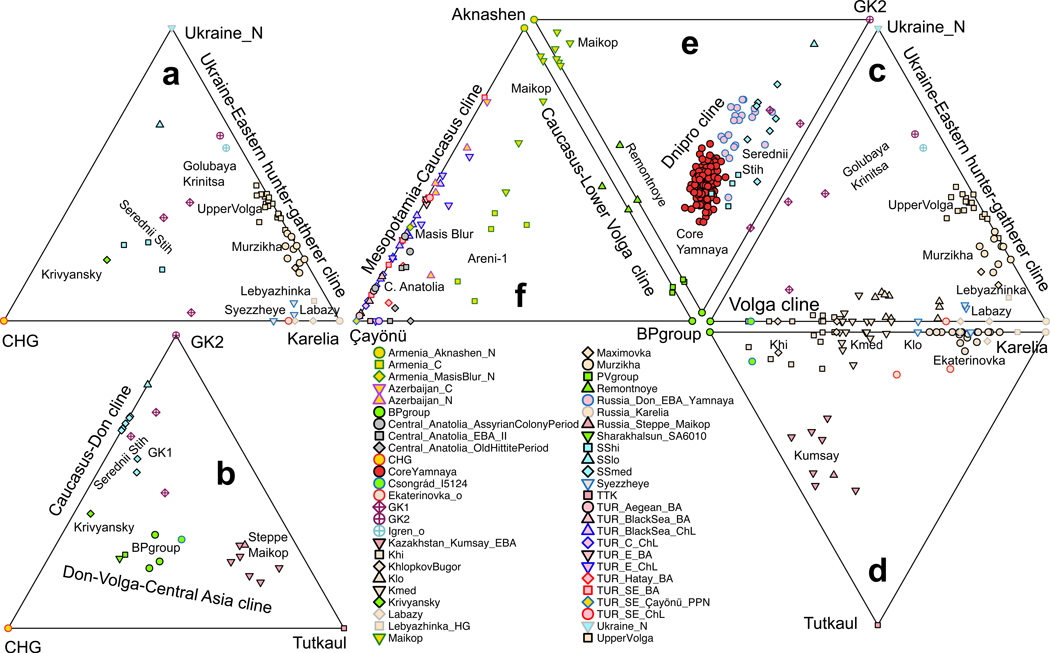
Before 4000 BCE, the steppe contained several populations with different mixtures of Caucasus, European hunter-gatherer and Siberian-related ancestry. These mixtures formed three broad gradients: a Volga cline in the east, a Dnipro cline in the west and a Caucasus–Lower Volga cline between the southern Caucasus and the Lower Volga.
A new population appears on the Lower Volga
Between about 4450 and 4000 BCE, a population with an unusual ancestry profile lived beside the Lower Volga in present-day southern Russia. Four of its known members were buried at Berezhnovka-2, close to the river. A genetically similar man was buried farther south at Progress-2, near the northern foothills of the Caucasus. Because these five people were so closely related genetically, researchers treat them as one population and call it the Berezhnovka–Progress group, shortened to BPgroup.
To reconstruct this population, the model first uses an older population from Krivyansky on the Lower Don. Krivyansky was 56.7% Caucasus hunter-gatherer, or CHG, and 43.3% GK2. GK2 was itself 66.6% Ukrainian Neolithic hunter-gatherer, or UNHG, and 33.4% eastern hunter-gatherer, or EHG. Expanding the model therefore gives Krivyansky an ancestry profile of approximately 56.7% CHG, 28.8% UNHG and 14.5% EHG.
BPgroup inherited 76% of that Krivyansky profile. The other 24% came from a population represented by Tutkaul, a Mesolithic individual from present-day Tajikistan. Tutkaul supplies the Central Asian and Siberian-shifted ancestry that was absent or nearly absent on the Lower Don. If the nested Krivyansky model is expanded, BPgroup is approximately 43.1% CHG/Iran, 21.9% UNHG, 11.0% EHG and 24.0% Tutkaul. These figures express the direct 76:24 model in its underlying components. A separate three-source test estimated the Tutkaul contribution at 29.3 ± 2.2%, showing the uncertainty produced when different source combinations are used.
Ukrainian Neolithic hunter-gatherers were themselves a mixture of eastern and western hunter-gatherers. In the qpAdm model of Mathieson and colleagues (2018), UNHG was approximately 57% EHG and 43% WHG. Splitting the 21.9% UNHG share on that ratio gives about 12.5% EHG and 9.4% WHG. Added to the 11.0% EHG already present, BPgroup resolves to roughly 43.1% CHG/Iran, 23.5% EHG, 9.4% WHG and 24.0% Tutkaul. Here CHG/Iran combines Caucasus and Iranian Neolithic ancestry, which these nested source models do not separate; a direct distal qpAdm splits them.
Krivyansky contained only 5.1 ± 3.6% Tutkaul ancestry in the three-source test, a value statistically compatible with little or none. BPgroup required 29.3 ± 2.2%. That difference in Central Asian ancestry is the clearest genetic distinction between the Lower Don population and BPgroup on the Lower Volga.
The Volga cline
BPgroup mixed with EHG populations farther upriver. Ekaterinovka was 24.3% BPgroup and 75.7% EHG. At Khvalynsk, the low group was 41.2% BPgroup and 58.8% EHG, the middle group was 57.3% BPgroup and 42.7% EHG, and the high group was 76.8% BPgroup and 23.2% EHG. Across all sampled populations on the Volga cline, BPgroup ancestry ranged from roughly 14% to 89%.
The Dnipro region followed another history. The local source labelled GK2 was 66.6 ± 4.7% Ukrainian Neolithic hunter-gatherer and 33.4 ± 4.7% EHG. During the fifth millennium BCE, migrants from the Caucasus–Lower Volga network mixed with this Dnipro-Don population. The resulting Serednii Stih communities formed the western half of the ancestry later brought together in Yamnaya.
The Caucasus–Lower Volga network
Between about 5000 and 3500 BCE, the populations between the southern Caucasus and the Lower Volga formed a single genetic gradient, or cline, in which Caucasus ancestry decreases and Lower Volga ancestry increases from south to north. They exchanged ancestry as well as copper, stone, livestock and burial practices, and are known together as the Caucasus–Lower Volga, or CLV, network.
The two ends of the cline are Aknashen in the south and BPgroup, the Lower Volga population described above, in the north. The populations in between are modelled as mixtures of these two, carrying more BPgroup ancestry the farther north they lived.
Aknashen, the southern anchor
Aknashen was a Neolithic farming settlement on the Ararat plain of Armenia, occupied between about 5985 and 5836 BCE. Its genomes, with those of nearby Masis Blur, are the oldest ancient DNA from Neolithic Armenia.
Lazaridis and colleagues model Aknashen as deriving about 42.0 ± 3.8% of its ancestry from Caucasus hunter-gatherers (CHG) and about 58% from Anatolian Neolithic farmers. Aknashen had almost no Levantine ancestry, and its high CHG share is the main genetic difference from other Near Eastern farmers. Nearby Masis Blur had less CHG, about 13.7%, and a little more Levantine ancestry.
Aknashen-related farmers moved north from the South Caucasus around 6000 BCE and mixed with BPgroup on the Lower Volga. That mixture produced the populations of the cline.
Remontnoye, north of the Caucasus, was 44.6% Aknashen and 55.4% BPgroup. A model using the later Maikop population in place of Aknashen gives 48.1% Maikop and 51.9% BPgroup.
Expanding Aknashen and BPgroup into their own sources gives Remontnoye's ultimate ancestry. With UNHG split into EHG and WHG, Remontnoye is approximately 42.6% CHG/Iran, 25.9% Anatolian Neolithic, 13.0% EHG, 13.3% Tutkaul and 5.2% WHG.
Keeping UNHG as a single source instead gives 42.6% CHG/Iran, 25.9% Anatolian Neolithic, 12.1% UNHG, 6.1% EHG and 13.3% Tutkaul.
From south to north, BPgroup ancestry rises across the sampled populations: near zero in the Armenian farmers, 13.8% in the main Maikop cluster of the northern Caucasus, 55.4% in Remontnoye, and effectively all of it in BPgroup. That rising proportion is the Caucasus–Lower Volga cline.
The gradient did not follow latitude exactly. Some people buried near one another had ancestry from distant parts of the network, and shared DNA segments link individuals from the Lower Volga, the Dnipro region, Armenia and the northern Caucasus. These connections identify CLV as a mobile network rather than a single settlement or archaeological culture.
The Serednii Stih culture
The Serednii Stih, or Sredny Stog, was an Eneolithic culture of the North Pontic steppe in present-day Ukraine, dated to about 4500 to 3500 BCE. It formed on the Dnipro when steppe people carrying Remontnoye-like ancestry moved west and mixed with the local Ukrainian Neolithic hunter-gatherers. Serednii Stih is the population from which Core Yamnaya mainly descends.
The thirteen sampled Serednii Stih individuals, dated between about 5000 and 3400 BCE, vary in ancestry along a cline between the local Ukrainian Neolithic hunter-gatherers (UNHG) and Remontnoye. Lazaridis and colleagues split them into SSlo, SSmed and SShi, meaning low, medium and high Remontnoye ancestry. The hunter-gatherer source is UNHG, or GK2, which is 66.6% UNHG and 33.4% EHG.
SShi is the Remontnoye-rich end of the cline, and Core Yamnaya formed from it. Its proximal model is 73.7 ± 3.4% SShi and 26.3 ± 3.4% Remontnoye.
A distal qpAdm model gives Yamnaya's ancestry as about 32% Eastern hunter-gatherer (EHG), 21% Caucasus hunter-gatherer (CHG), 18% Tutkaul, 13% Iranian Neolithic, 12% Anatolian Neolithic and 4% Western hunter-gatherer (WHG).
The mixture dates to about 4038 BCE. Serednii Stih still contained people at widely different points along the cline, whereas later Core Yamnaya was genetically much more uniform. A Remontnoye-rich part of the Serednii Stih population expanded and became the main ancestral population of Yamnaya.
The formation of the Yamnaya population
Yamnaya communities became archaeologically visible across the steppe around 3300 BCE. Their ancestry had already become comparatively homogeneous during the preceding centuries. Genetic estimates place the main period of population growth between approximately 3640 and 3370 BCE, shortly before Yamnaya burial customs and material culture spread across the grasslands.
The expansion was rapid. Closely related Yamnaya ancestry appears from Hungary to the Altai, a distance of about 5,000 kilometres. Individuals buried thousands of kilometres apart shared long segments of DNA, demonstrating that movement across the steppe connected people within only a few generations.
Male lines became especially restricted. Most Yamnaya men belonged to closely related branches of Y-chromosome haplogroup R1b-M269, whereas mitochondrial lineages remained more diverse. The pattern points to a society organised around expanding paternal descent groups. Kurgan burial and the use of wheeled transport helped these groups maintain connections across a territory larger than any earlier steppe population had occupied.
The growth of Yamnaya did not mean that every local population vanished immediately. Mixing occurred at the edges of the expansion, and later populations combined Yamnaya ancestry with local farmers and hunter-gatherers. The first Yamnaya horizon nevertheless carried an unusually uniform genetic profile over its core territory.
That local mixture can be measured east of the core zone. Yamnaya individuals from the Don were 79.4 ± 1.1% Core Yamnaya and 20.6 ± 1.1% UNHG. Their extra UNHG ancestry records mixture with the older hunter-gatherer population of the Dnipro-Don steppe.
The older branch reached Anatolia
The Anatolian branch had separated from the ancestors of the remaining Indo-European languages before the Yamnaya expansion. Linguistic estimates place this Indo-Anatolian split broadly between 4300 and 3500 BCE. The genetic evidence points to the CLV network as the population connecting the two branches.
The southward route can first be measured at Areni-1 in Chalcolithic Armenia around 4300–4000 BCE. The Areni population was 26.9 ± 2.3% BPgroup and 73.1 ± 2.3% Masis Blur. Its local Masis Blur source can itself be modelled as 33.9 ± 8.6% Aknashen and 66.1 ± 8.6% Çayönü, a Pre-Pottery Neolithic population from the upper Tigris basin.
Central Anatolians from the Early Bronze Age, Assyrian Colony period and Old Hittite period combined a Çayönü source with ancestry from this northern route. Three alternative models fit the same signal: 10.8 ± 1.7% BPgroup and 89.2% Çayönü; 19.0 ± 2.4% Remontnoye and 81.0% Çayönü; or 33.5 ± 4.8% Chalcolithic Armenian and 66.5% Çayönü. The source changes because BPgroup, Remontnoye and Chalcolithic Armenia represent successive stages along the route. The percentages belong to separate models and are never added together.
The route into Anatolia was probably eastern. The central Anatolian genomes lack the European farmer and hunter-gatherer ancestry expected if the migrants had crossed the Balkans from the west. Genetics cannot identify the language spoken by an individual skeleton, but the timing, location and shared CLV ancestry connect this migration with the population from which the Anatolian and steppe branches had already separated.
Steppe ancestry enters Europe
Corded Ware groups spread across central and northern Europe from about 3000 BCE. Their steppe ancestry closely resembled Yamnaya, but their Y-chromosomes were mostly R1a-M417 rather than the R1b-Z2103 carried by Yamnaya men. Corded Ware and Yamnaya were separate branches of the same steppe population, the Serednii Stih. Most of the remaining Corded Ware ancestry came from Globular Amphora.
Corded Ware descendants gave rise to several later expansions. Bell Beaker communities carried steppe ancestry into western Europe and Britain. Fatyanovo moved east into the forest zone, while Sintashta communities developed farther east with fortified settlements, chariots and the ancestry associated with the later spread of Indo-Iranian languages.
Other steppe-derived movements reached the Balkans and contributed to populations ancestral to Greek, Armenian and the poorly documented Indo-European languages of southeastern Europe. Each regional language developed after mixture with local populations. The shared steppe ancestry identifies the main demographic route without implying that later Greeks, Celts, Germans or Indo-Iranians were genetically identical.
Yamnaya moved east to the Altai
One branch of the Yamnaya expansion travelled more than 3,000 kilometres east and formed the Afanasievo horizon in the Altai and Mongolia around 3000 BCE. Afanasievo is the clearest direct descendant of Yamnaya: the genomes are closely related and the men carried the same R1b-Z2103 lineage, with little sign of mixture during the initial migration.
This movement provides the strongest population route for the ancestors of Tocharian, the second major branch to separate after Anatolian. Tocharian languages were recorded much later in the Tarim Basin, but their early linguistic position and the direct Yamnaya-to-Afanasievo migration place their deeper history on the eastern steppe.
Where the common language formed
The genetic reconstruction places the ancestry shared by Yamnaya and Bronze Age central Anatolians in the CLV network north of the Caucasus. It does not reveal the exact community in which Proto-Indo-Anatolian was first spoken. Language can spread without a large population movement, and no genetic method can read a language from a genome.
The chronology nevertheless narrows the problem. CLV-related populations existed before the split between Anatolian and the remaining Indo-European branches. Their descendants moved south toward Anatolia and west into the Serednii Stih population from which Yamnaya formed. Yamnaya then carried the ancestor of the non-Anatolian branches across the steppe.
This explains why Anatolian languages share a deep linguistic relationship with Indo-European while Bronze Age Anatolians lack the large Yamnaya component found in many later Europeans and Central Asians. Both expansions began from the same older population network, but they separated before Yamnaya became a distinct and rapidly growing population.